
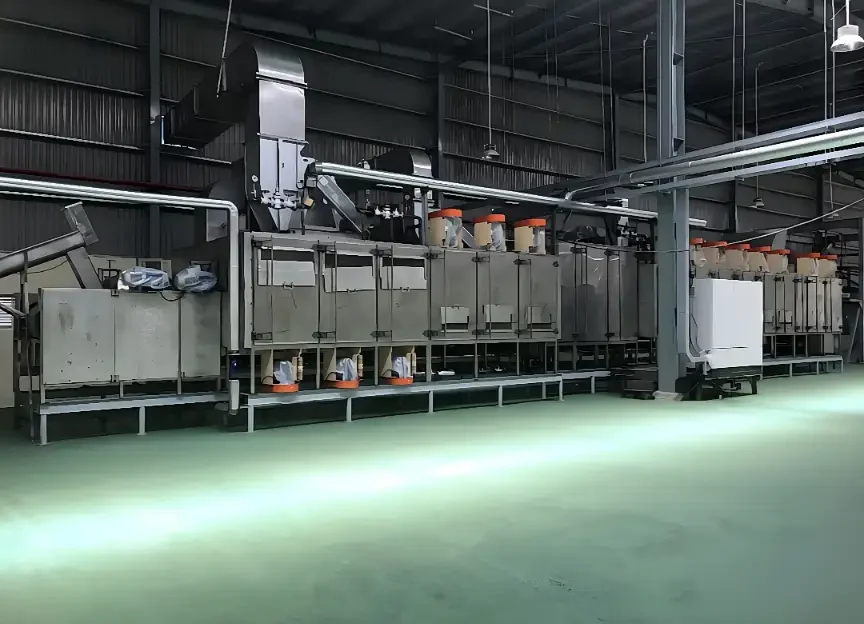
Industrial coconut drying is one of the most critical stages in the production of desiccated coconut and other value-added coconut products. The selected drying system directly influences final moisture, colour, texture, production capacity, energy consumption and overall product consistency.
For commercial coconut processing plants, two practical drying technologies are the Band Dryer and the Combination Dryer. Both can be engineered for continuous production, but their operating principles and suitability differ depending on the product, capacity and drying requirement.
GEM Cocotech designs customized coconut drying equipment based on actual process conditions rather than selecting a dryer only by nominal capacity.
Why Is Drying Important in Coconut Processing?
Fresh coconut material contains substantial moisture. If the moisture is not reduced under controlled conditions, the finished product can face problems such as:
- Reduced shelf life
- Uneven moisture distribution
- Product discoloration
- Microbial deterioration
- Poor texture
- Inconsistent product quality
- Higher storage and packaging risks
An industrial coconut drying machine should therefore provide controlled temperature, airflow and residence time while maintaining the required product characteristics.
What Is a Band Dryer?
A Band Dryer, also known as a continuous belt dryer, transports coconut material through a controlled drying chamber on a moving perforated belt.
Hot air passes through or across the product bed while the belt speed controls the residence time.
Typical Process
Wet Coconut Feed → Uniform Spreading → Controlled Hot-Air Drying → Moisture Reduction → Cooling / Discharge
The dryer can be designed with multiple drying zones so that temperature and airflow can be adjusted progressively during the drying process.
Advantages of a Band Dryer for Coconut Processing
- Continuous operation
- Gentle product handling
- Adjustable residence time
- Controlled product-bed thickness
- Uniform airflow distribution
- Multiple drying zones possible
- Suitable for medium to high production capacities
- Flexible heating options
- PLC-based process control possible
A band dryer is particularly useful where the product requires controlled and relatively gentle drying over a defined residence time.
What Is a Combination Dryer?
A Combination Dryer combines different drying mechanisms or drying stages within a single process system.
The objective is to achieve efficient moisture removal while maintaining product quality and controlling the final drying stage more precisely.
For coconut applications, a combination drying system can be engineered where the first stage removes a larger portion of the moisture and the subsequent stage completes the drying under more controlled conditions.
Typical Concept
High-Moisture Coconut Feed → Primary Drying → Controlled Secondary Drying → Final Moisture Adjustment → Discharge
The exact configuration depends on:
- Initial moisture
- Final moisture
- Particle size
- Product quality requirement
- Production capacity
- Available utilities
Advantages of a Combination Dryer
A properly engineered combination drying system can provide:
- Efficient moisture removal
- Better utilization of drying energy
- Controlled final moisture
- Reduced drying bottlenecks
- Improved throughput
- Better flexibility for varying feed conditions
- More controlled finishing of the product
- Potential reduction in overall drying time
Combination dryers can be useful where a single-stage drying approach does not provide the desired balance between capacity, efficiency and product quality.
Band Dryer vs Combination Dryer for Coconut Processing
| Parameter | Band Dryer | Combination Dryer |
|---|---|---|
| Operation | Continuous | Continuous / integrated |
| Product handling | Gentle | Depends on configuration |
| Residence-time control | Excellent | Excellent |
| Moisture removal | Gradual | Multi-stage / optimized |
| Temperature control | High | High |
| Capacity flexibility | High | High |
| Feed moisture variation | Moderate to high | Better suited to wider variation |
| Energy optimization | Good | Potentially higher with proper integration |
| Product-quality control | Very good | Very good |
| Complexity | Moderate | Higher |
| Best suited for | Controlled continuous drying | Multi-stage or demanding drying duties |
When Should You Choose a Band Dryer?
A Band Dryer for coconut processing may be preferred when:
- Continuous production is required
- The product needs gentle handling
- Residence time must be carefully controlled
- Product-bed thickness can be maintained uniformly
- Drying should take place gradually
- High throughput is required
- The process benefits from multiple temperature zones
For desiccated coconut and similar food products, gentle and controlled drying can help maintain desirable product characteristics.
When Should You Choose a Combination Dryer?
A Combination Dryer may be more suitable when:
- Feed moisture varies significantly
- A large amount of moisture must be removed
- Different drying stages require different operating conditions
- The plant requires higher process flexibility
- The final moisture specification is tight
- Energy efficiency is a major design objective
- A single drying method is not sufficient for the process
The correct design should always be based on the actual material rather than selecting equipment only from a standard catalogue.
Important Parameters for Selecting a Coconut Drying System
Before selecting the dryer, the following information should be evaluated:
| Parameter | Why It Matters |
|---|---|
| Wet feed capacity | Determines overall dryer size |
| Initial moisture | Determines water evaporation load |
| Required final moisture | Defines drying duty |
| Product size | Influences airflow and drying rate |
| Bulk density | Influences loading and belt area |
| Drying temperature | Important for product quality |
| Residence time | Determines drying completion |
| Available heating source | Affects operating cost |
| Operating hours | Influences required capacity |
| Final product specification | Determines dryer configuration |
Heating Options for Coconut Drying
Depending on plant infrastructure and project requirements, industrial drying systems may be designed around different heat sources such as:
- Steam
- Thermic fluid
- Electrical heating
- Hot air generator
- Biomass-based heating
- Suitable process waste heat
The correct heat source should be selected after evaluating energy cost, availability, temperature requirement and operating conditions.
How Is Dryer Capacity Calculated?
Dryer selection should not be based only on the wet feed rate.
The most important calculation is the amount of water that must be evaporated.
For example:
If the feed rate is:
1,000 kg/hr
and the initial moisture content is high, the dryer may need to remove several hundred kilograms of water every hour.
The required dryer size therefore depends on:
Feed Rate + Initial Moisture + Final Moisture + Drying Temperature + Residence Time
Two customers processing the same quantity of coconut may require very different dryers if their initial and final moisture specifications differ.
Why Product Testing Is Important Before Dryer Selection
Coconut products can behave differently during drying depending on:
- Particle size
- Fat content
- Initial moisture
- Feed preparation
- Product thickness
- Air temperature
- Air velocity
- Drying time
Selecting a commercial drying system without evaluating these variables can result in:
- Insufficient drying
- Excessive drying time
- High energy consumption
- Product discoloration
- Uneven moisture
- Lower production capacity
Dried & Tested – Proven, Not Assumed
GEM Cocotech follows a Dried & Tested approach for drying applications.
Pilot trials can help establish:
- Suitable drying temperature
- Residence time
- Moisture-removal rate
- Product behaviour
- Final moisture
- Product appearance
- Suitable dryer configuration
The data generated during trials can then support the design and sizing of the commercial drying system.
This allows dryer selection to be based on actual product performance rather than assumptions.
Which Dryer Is Better for Coconut Processing?
There is no single answer for every coconut-processing plant.
A Band Dryer can be an excellent choice when continuous, gentle and controlled drying is required.
A Combination Dryer can provide advantages where the process requires multiple drying stages, higher flexibility or optimized moisture removal.
The correct choice depends on:
- Raw material characteristics
- Production capacity
- Moisture-removal requirement
- Product-quality specification
- Heating availability
- Plant layout
- Energy-consumption targets
Conclusion
Selecting the correct coconut drying machine is an important engineering decision for any commercial coconut-processing facility.
Both Band Dryers and Combination Dryers can provide reliable drying performance when properly designed around the product and operating conditions.
Rather than selecting equipment only by capacity, coconut processors should evaluate actual moisture load, drying behaviour, product quality and utility availability.
GEM Cocotech develops customized coconut-processing and drying systems supported by process engineering and pilot trials.
Dried & Tested – Proven, Not Assumed.